
TL; DR:
An agentic operating layer helps logistics teams move from communication automation to workflow resolution. Voice AI can call drivers, customers, carriers, or warehouse teams, but an agentic layer decides what should happen after the call: update the shipment record, reschedule a delivery, escalate a dispute, trigger a reattempt, notify the right team, or hold an order before it creates more cost. Agentic AI systems are designed to plan, take action, and adapt with limited supervision, instead of only responding to a single prompt or script.
What is an agentic operating layer in logistics?
An agentic operating layer is a decision-and-action layer that sits across logistics systems and frontline workflows. It reads signals from tools such as TMS, WMS, OMS, CRM, courier dashboards, call systems, emails, WhatsApp threads, and support tickets. It then decides the next operational step within clear rules.
In plain terms, it is the layer between “something went wrong” and “someone fixed it.”
A voice bot can call a driver and ask why a delivery is delayed. An agentic operating layer can take the driver’s answer, check the customer’s availability, compare the promised delivery window, update the dispatch board, send a revised ETA, and route the case to a human if the reason looks risky. The voice call is one input. The workflow decision is the heavier work.
IBM describes agentic automation as automation powered by AI agents that can make decisions and take actions autonomously, adapting to changing environments and goals rather than following only fixed rules. Google Cloud similarly describes agentic AI as systems that can gather information, reason, plan, act, and reflect on the result.
Why voice automation alone is too thin for logistics
Voice is often the first visible use case because logistics still runs on calls. Drivers call when they cannot find a gate. Customers call when a delivery window slips. Dispatchers call carriers for status. Warehouse teams call to confirm pickup slots. The work has a phone-shaped surface because field operations are full of moving parts and partial information.
But the call is rarely the whole workflow. A customer says they are available after 6 PM. That answer has to touch the route plan. A driver says the address is incomplete. That detail has to reach the delivery instruction layer.
A carrier says the truck is delayed. That update has to change the appointment slot, customer ETA, and escalation status. If the answer stays trapped inside a transcript, the team still has to copy the truth from one place to another.
This is where voice automation starts to feel busy but shallow. The system speaks, listens, and logs. Then the human team still drags the case through the rest of the workflow.
The real pressure in logistics sits in the handoff after the conversation.
Passive monitoring vs voice automation vs agentic operating layer
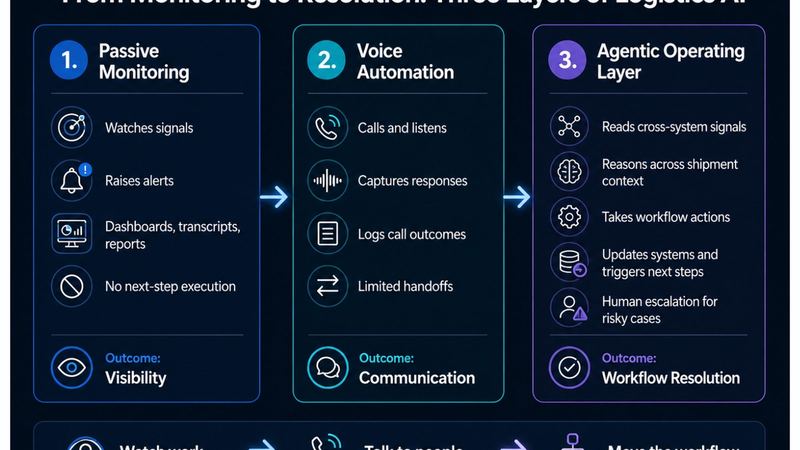
| Layer | What it does | Where it helps | Where it falls short |
| Passive monitoring | Shows status, alerts, dashboards, and reports | Visibility after events are recorded | Waits for humans to interpret and act |
| Voice automation | Calls drivers, customers, carriers, or teams | Repetitive communication at scale | Repetitive communication at scale |
| Workflow automation | Moves cases through predefined rules | Moves cases through predefined rules | Stable, predictable process steps |
| Agentic operating layer | Reads context, cough tools, and escalates when needed | Exception-heavy logistics work | Needs strong rules, integrations, monitoring, and human review boundaries |
The useful shift is from watching work to moving work. Logistics teams already have dashboards. What they lack is a reliable layer that can smell an exception early, touch the right systems, and carry the case forward before the queue stiffens.
Why logistics is a natural fit for agentic AI
Logistics workflows are full of small decisions that are too frequent for senior operators but too messy for rigid automation. A delayed delivery may need a customer call, route adjustment, warehouse update, support note, and courier escalation. A failed pickup may need address correction, packaging readiness check, refund hold, and reattempt scheduling. A carrier delay may require appointment rescheduling and customer communication before the dock turns into a bottleneck.
Traditional automation handles clean pathways. Logistics is crowded with half-clean pathways.
DHL’s Logistics Trend Radar 7.0 reported that AI’s relevance in logistics has expanded and highlighted Generative AI, AI Ethics, Audio AI, Computer Vision, and Advanced Analytics as major AI trends shaping logistics over the next decade. DHL also says these AI trends can enhance human-computer interaction through voice and sound analysis, automate visual data interpretation, and support more sophisticated analysis across logistics processes.
The direction is already visible in live operations. DHL Supply Chain announced in November 2025 that it had expanded its use of HappyRobot AI agents across appointment scheduling, driver follow-up calls, and high-priority warehouse coordination. DHL said these agents handle phone and email interactions and support workflows involving hundreds of thousands of emails and millions of voice minutes annually.
That kind of deployment tells you where the market is moving. The first layer is communication. The deeper layer is operational control.
What an agentic operating layer can do in logistics?
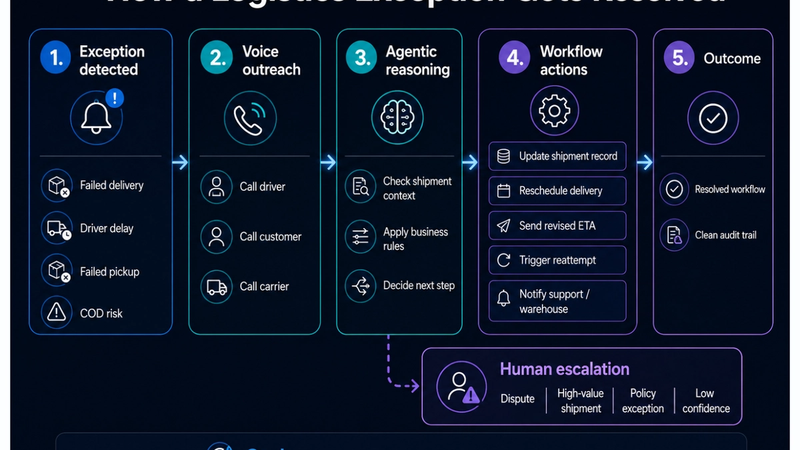
| Workflow | Signal detected | Agentic action | Human role |
| Failed delivery | Customer unavailable or address issue | Call customer, collect reattempt slot, update NDR workflow | Review disputes and high-value cases |
| COD risk | Buyer unreachable or weak intent | Hold order, retry call, trigger prepaid nudge, flag risky shipment | Approve rules for expensive orders |
| Return pickup failure | NPR created | Call customer, confirm packaging readiness, reschedule pickup | Handle courier/customer mismatch |
| Driver delay | Driver reports late start or breakdown | Update dispatch, notify customer, escalate route risk | Reassign route if needed |
| Warehouse appointment issue | Slot conflict or late arrival | Reschedule appointment and notify carrier | Resolve capacity conflicts |
| Carrier coordination | Missing status update | Call carrier, capture ETA, update shipment status | Intervene on repeated failures |
| Customer escalation | Repeated failed contact or angry response | Create priority case with call history and shipment context | Own final resolution |
The pattern is the same across these workflows. The system does not merely speak. It reads the situation, acts inside the workflow, and hands off only when the case needs judgment.
Where does the voice sit inside the agentic layer?
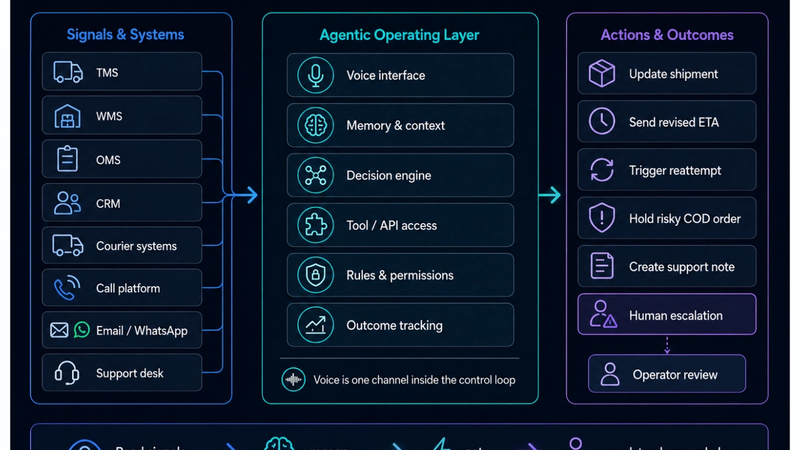
Voice is the mouth and ear of the operating layer.
It reaches people who will not answer a ticket, open a dashboard, or respond quickly to a message. It is especially useful for urgent field questions: Can the driver reattempt delivery? Is the customer available? Is the return item packed? Has the carrier reached the dock? Does the customer still want the COD order?
But the agentic layer needs more than a voice model. It needs memory, tool access, permissions, escalation rules, and outcome tracking. AI agents can interact with APIs and databases, use information to make decisions, and take actions, while also coordinating subtasks in multi-agent systems.
Without those pieces, the voice agent becomes a pleasant caller that creates more admin. With those pieces, the call becomes one part of a working control loop.
How does this change logistics operations?
Most logistics teams still operate through a tired rhythm: alert, call, note, wait, escalate, chase again. The same case gets touched by dispatch, support, warehouse, courier, and finance, each team seeing a slightly different version of the truth. By the time someone has the full picture, the parcel may already be returning, the pickup slot may already be missed, or the customer may already be typing a complaint.
An agentic operating layer compresses that delay.
A failed delivery can trigger customer contact within minutes. A driver delay can update the dispatch view before the next route review. A failed pickup can move into reattempt scheduling without waiting for a support agent to open the queue. A risky COD order can be held before the warehouse spends time packing it.
The gains come from fewer cold handoffs and fewer cases sitting still because nobody owns the next move.
What teams should measure
| Metric | Why it matters |
| Time from exception to first action | Shows whether the system reacts before the case hardens |
| Manual touches per shipment exception | Reveals how much human chasing remains |
| NDR or NPR recovery rate | Measures whether failed deliveries or pickups are being rescued |
| Escalation quality | Shows whether humans receive useful context, not vague alerts |
| Workflow completion rate | Measures whether the agent closes the loop, not only starts it |
| Override rate | Shows where human teams distrust or correct the system |
| Repeat exception rate | Reveals whether the same root causes keep returning |
| Cost per resolved exception | Connects the layer to operating economics |
Call volume is a weak metric for this category. The better question is how many cases moved from broken to resolved with fewer human touches and cleaner evidence.
Where agentic operating layers can fail
The risk is not that agentic systems are too weak. The risk is that they are given vague jobs with too much permission.
A logistics agent should not freely cancel high-value orders, penalize drivers, approve refunds, or override courier rules without boundaries. It should not treat every customer refusal as final or every courier failure reason as true. It should not hide its reasoning inside a black box when money and service quality are at stake.
Agentic AI needs operating discipline. Define which decisions it can make alone, which decisions need human approval, which systems it can update, how it handles failed calls, how it records evidence, and how teams audit the outcome. IBM notes that agentic systems can work with human-in-the-loop methods when they are unsure how to handle a situation, which is especially important in workflows where the cost of a wrong decision is high.
The best rollout is narrow and slightly boring. Start with one exception type where the next action is clear. Watch how operators override the system. Tighten the rules. Then widen the workflow.
How ReachAll.ai fits this workflow
ReachAll.ai starts with voice because many logistics exceptions still begin or end with a call. A customer needs to confirm availability. A driver needs to explain a delay. A carrier needs to share an updated ETA. A return customer needs to confirm whether the item is ready for pickup. These are not abstract automation problems but live operating moments where someone needs to ask, listen, and move the case forward.
The larger opportunity is what happens after the call. ReachAll.ai is useful when the voice interaction becomes part of a wider operating flow: updating a shipment record, triggering a reattempt, flagging a risky COD order, escalating a disputed delivery, or giving a human operator enough context to make the next decision faster.
This is where voice automation begins to look more like an operating layer. The system is no longer only making calls. It is helping logistics teams carry exceptions from detection to action, with humans staying involved where judgment, policy, or customer trust is at stake. Book a demo to know more.
If you want the workflow-level breakdown first, our guide on Voice AI for Logistics: Use Cases Across Dispatch, RTO, COD Verification, and Reverse Logistics maps where voice AI fits before the broader agentic layer comes into play.
Final take
Voice automation is a useful entry point because logistics still runs through calls. The deeper opportunity is a system that can hear the call, understand the shipment context, update the right record, trigger the next step, and bring a human in when the case carries risk.
Most logistics teams do not need another dashboard glowing in the corner. They need the sticky work between systems to move faster: the missed delivery, the failed pickup, the COD order with weak intent, the driver delay, the carrier update, the warehouse slot that needs to shift before the dock gets crowded.
An agentic operating layer is valuable when it turns those moments into handled workflows instead of leaving them as loose notes, stale alerts, and another call someone has to make later.
Frequently Asked Questions (FAQs)
What is an agentic operating layer in logistics?
An agentic operating layer is software that reads logistics signals, reasons across systems, and triggers workflow actions such as customer calls, driver follow-ups, shipment updates, reattempt scheduling, and human escalation. It is designed to help logistics teams resolve exceptions rather than only monitor them.
How is an agentic operating layer different from voice AI?
Voice AI handles spoken communication. An agentic operating layer uses voice as one channel inside a broader workflow. It can also read shipment data, update systems, trigger escalations, apply business rules, and decide the next operational step within approved boundaries.
Why does logistics need agentic AI?
Logistics teams deal with repeated exceptions across delivery, dispatch, returns, carrier coordination, and warehouse operations. Many of these exceptions require action across multiple systems. Agentic AI is useful because it can gather information, plan a next step, act through tools, and escalate cases that require human judgment.
Does agentic AI replace logistics operations teams?
Agentic AI should reduce repetitive chasing, not remove human operators from high-stakes decisions. Humans should still handle disputes, high-value shipments, refund risk, courier performance issues, safety incidents, and cases where the system lacks enough context.
What is the best first use case?
The best first use case is a frequent exception with a clear next step. Failed delivery recovery, failed pickup recovery, COD verification, appointment scheduling, driver follow-up calls, and carrier status checks are practical starting points because the questions are repetitive and the outcomes can be measured.
What should an agentic logistics system integrate with?
It should connect with the tools where logistics work already happens: TMS, WMS, OMS, CRM, courier systems, support desk, call platform, WhatsApp or SMS tools, and internal escalation workflows. The system needs both read access and controlled write access, otherwise it cannot close the loop.