
Hamming AI is a strong option for automated testing and monitoring Voice AI agents across the agent lifecycle.
But since you’re here looking for Hamming AI alternatives, it could be for any of these common reasons that apply to most such platforms:
- It’s either giving you too many false alarms, or missed some real issues
- The test cases look good on paper, but the real calls are still messy as the tool is unable to detect what’s breaking in production
- You may want faster answers related to what broke and how to fix it
- You might also face cost issues
This guide is written for two buyer types:
- Teams running voice agents in production (support, sales, collections, scheduling, healthcare, BFSI, etc.).
- Voice AI builders (platforms and agencies) who need a QA and monitoring layer they can rely on across many deployments.
Let’s dive in!
Top 6 Hamming AI Alternatives (At A Glance)
| Tool | Best fit for | What you'll like | Watch-outs |
| ReachAll | If you want a full-stack platform with QA + control layer and an option to go fully managed | A full-stack platform; Voice agent + monitoring + QA in one system, reliability loop built around real production calls, option to run it hands-off | If you only want call recording and basic tags, this can be more than needed |
| Cekura | If you want broader automated QA coverage and lots of scenario-based simulations | Strong simulation and automated QA approach across many conversational scenarios, helpful for expanding test breadth quickly | Voice-specific depth depends on how your voice stack is instrumented; may not be the best “voice-only ops” tool |
| Roark | If you want replay-based debugging and turning failed calls into test cases | Deep focus on testing + monitoring voice calls, including real-world call replay | More “QA platform” than “ops + managed execution” |
| Coval AI | If you want deep debugging and evaluation at scale | Simulate + monitor voice and chat agents at scale, with an evaluation layer your whole team can use | If you want deep voice pipeline tracing, confirm what you get out of the box vs what you need to configure |
| SuperBryn | If you want a lighter-weight eval/monitoring workflow | Voice AI evals + observability with a strong “production-first” angle (including tracing across STT → LLM → TTS) | Less public clarity on voice-specific depth vs others |
| Bluejay | If you want end-to-end testing with real-time explainability plus human insight | Scenario generation from agent + customer data, lots of variables, A/B testing + red teaming, and team notifications | Can feel like a testing lab if you want “operational control” |
Top 6 Hamming AI Alternatives (Deep Dives)
Find out the right fit for you below:
1) ReachAll: Best for teams who want an all-in-one setup; a full-stack Voice AI + QA with control layer
ReachAll is the best option when your problem is not “can we test this agent,” but “can we run this agent at scale without any surprises.”
It’s a full-stack Voice AI platform that combines the voice AI agent layer with a monitoring and QA layer that tracks conversations, flags issues, and supports continuous improvement.
Also, if you do not want to staff AI QA and voice ops internally, ReachAll is one of the few options with a fully managed path.
Key features that matter for voice AI monitoring
- Deployed-agent QA + observability: evals on production calls, monitoring across STT/LLM/TTS, and alerts when quality dips.
- Control-loop approach: detect, diagnose root cause, propose fixes, and validate changes against tests before rollout (useful when your biggest pain is slow iteration)
- All-in-one stack: Get ReachAll voice agent + QA,or integrate with your existing voice stack as a QA + governance layer.
Why ReachAll stands out vs Hamming AI?
- You get root cause, not just a score.
ReachAll offers QA + Governance stack around tracing failures across the full pipeline (STT, LLM, TTS) and pinpointing where the breakdown happened, so you’re not guessing what to change. - It’s designed to help you fix issues safely, not just find them.
The promise is detect → diagnose → propose fixes → validate against test suites → deploy without regressions. That “tested fixes” loop is the main difference versus tools that stop at evaluation and monitoring. - It treats QA as an operating system for production, not a periodic audit.
It’s conducts continuous evaluation on real traffic, with observability, alerting, and governance controls running all the time, so reliability becomes part of daily ops. - You can run it across your stack, not only inside one voice platform.
ReachAll’s QA + Governance layer can sit across STT/LLM/TTS components and work even if you run another production voice stack. That matters if you don’t want to swap your whole stack just to get better monitoring. - If your bottleneck is ops bandwidth, ReachAll is built to be hands-off.
They “build, test, deploy, evaluate, fix, scale” with no engineering overhead. That’s a real differentiator if you’re tired of stitching together tools and staffing QA manually.
If Hamming AI is helping you measure agent quality, ReachAll is trying to help you operate agent quality in production, with a loop that can actually push improvements without breaking working flows.
Best for
- Teams who want to stop treating QA as a separate project and make reliability part of daily operations
- Businesses that cannot afford missed calls, broken booking flows, or silent failures
- Voice AI Builders/partners who want to offer “reliability as a feature” to their own customers
Pros and Cons
| PROS | CONS |
| Strong fit when you care about production reliability and continuous improvement loops | t’s a bigger platform decision as it is more than a “QA add-on.” |
| Reduces tool sprawl because monitoring and QA live with the voice system | |
| Option to run it hands-off with a managed approach (useful when you don’t want to staff Voice AI QA) |
Book a Demo
2) Roark: Best for replay-based debugging and turning failed calls into test cases
Roark is a strong pick when you want to use production calls as your test suite. The core value is replaying real calls against your latest changes so you catch failures before customers do, then tracking how things change across versions.
Key features that matter for voice AI monitoring
- Voice-agent testing + monitoring workflows designed around real calls (not just toy prompts)
- Replay-driven debugging for catching regressions in real conversations
- Focus on metrics that matter for voice, not generic chat-only evaluation
Best for
- Voice teams that ship fast and need high-confidence regression coverage
- Products where tone, barge-in, interruptions, and pacing materially affect conversion/support outcomes
Pros and Cons
| PROS | CONS |
| Good fit when you care about voice realism and production replay as the source of truth | Less compelling if you want a fully managed ops layer |
| Helps teams move beyond “text-only evals” that miss voice failure modes | May require more setup work than “business user” teams want |
| Strong match for engineering teams building voice at speed |
3) Cekura: Best for heavy simulation and scenario generation
Cekura is a solid alternative when you want to test breadth. It focuses on generating many conversational scenarios and running simulations so you can find edge cases earlier, especially in voice and chat agent flows.
Key features that matter for voice AI monitoring
- Automated scenario generation for wide coverage.
- Simulation-driven QA to stress the agent before production.
- Monitoring and testing aimed at catching issues across varied interactions.
Best for
- Teams that want more synthetic test coverage than their current setup provides.
- Builders who need stress tests and a broad scenario library mindset.
Pros and Cons
| PROS | CONS |
| Strong simulation focus for catching edge cases early | Depth of governance workflows varies by implementation needs |
| Helpful for stress testing and breadth | |
| Works across voice and chat |
4) Bluejay: Best for end-to-end testing with real-time explainability plus human insight
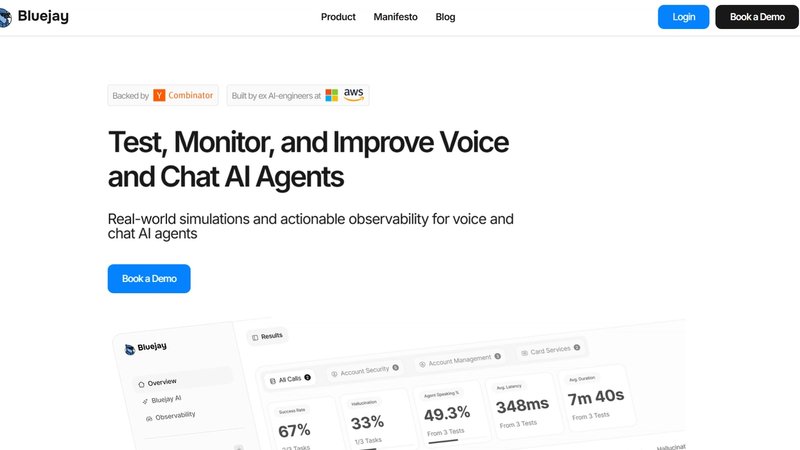
Bluejay is a good option when you need to test and monitor agents across channels, not just voice. It leans into “real-world” simulation variables and ongoing monitoring so teams can spot regressions and failures across deployments. You get both technical and human insights.
Key features that matter for voice AI monitoring
- Auto-generated scenarios and extensive variable coverage (helpful for scale)
- A/B testing and red teaming workflows
- Observability + notifications so issues don’t sit in dashboards
Best for
- Voice teams that want broader test coverage quickly
- Teams running multilingual or multi-market voice deploymentsne calls.
Pros and Cons
| PROS | CONS |
| Great when your main bottleneck is coverage and edge cases | Can feel like a testing lab if your pain is operational ownership and rapid remediation |
| Strong for systematic scenario generation, not just ad-hoc testing | Still requires a clear internal workflow to turn failures into changes |
| Helpful for teams juggling many languages/flows | If you want voice agent + QA in one system, you may prefer an all-in-one platform |
5) Coval AI: Best for teams that want a broader agent evaluation stack with deep debugging and evaluation at scale
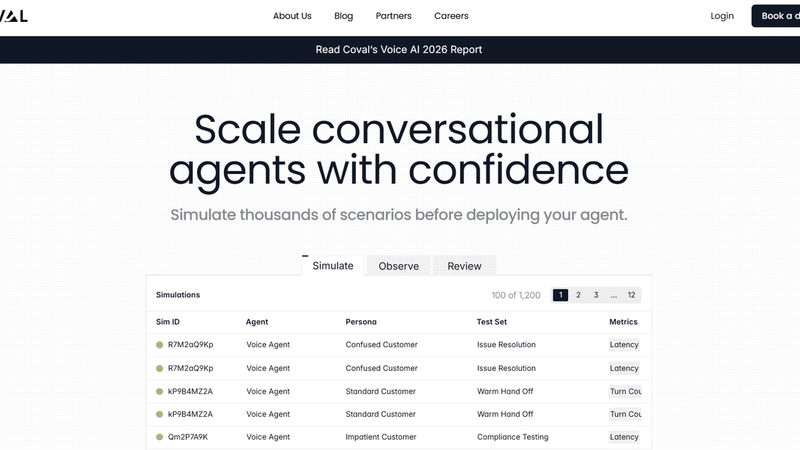
Coval is a practical alternative if your main goal is to test, evaluate, and improve voice agents quickly before customers feel the failure. It is built around simulations and evaluation workflows at scale that help teams iterate faster.
Key features that matter for voice AI monitoring
- Agent evaluation workflows and monitoring primitives that can extend to voice setups
- Useful when you want consistency across many AI systems, not a single voice agent
Best for
- Teams running multiple AI agents across functions
- Organizations that want a centralized “evaluation layer” across agent types
Pros and Cons
| PROS | CONS |
| Strong fit for teams treating evaluation as a shared platform capability | May feel heavyweight if you only need voice monitoring |
| Helps unify QA language across agents, not only voice | Less direct if your need is immediate production voice ops |
| Useful for experimentation and governance across AI apps |
6) SuperBryn: Best for teams that want a simpler evaluation loop without heavy infra
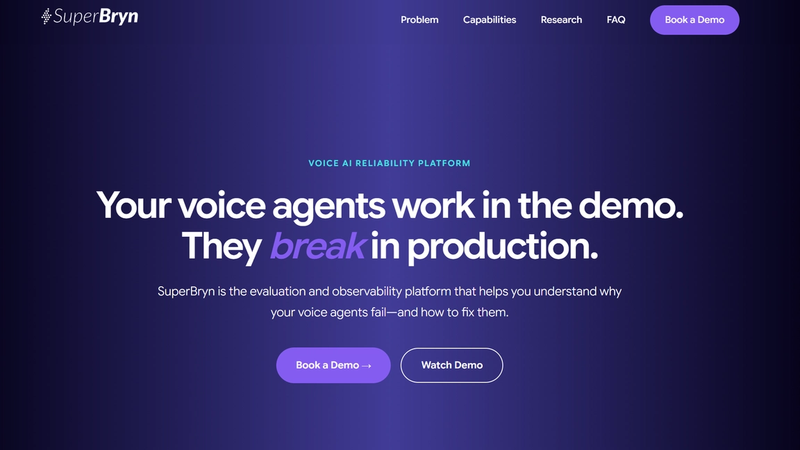
SuperBryn is built around a blunt truth: production breaks silently. It focuses on evaluation and observability to help teams understand why voice agents fail in real usage and what to fix next, without the burden of heavy infra.
Key features that matter for voice AI monitoring
- Lightweight evaluation/monitoring workflow that reduces time-to-first-signal
- Useful when you want to start with a practical QA loop and expand later
Best for
- Smaller teams, agencies, or internal voice projects that need a fast start
- Teams that want a simpler operational workflow before adding complexity
Pros and Cons
| PROS | CONS |
| Lower operational burden to get started | May not satisfy advanced enterprise governance requirements |
| Good “first QA loop” for teams new to voice monitoring | You may outgrow it if you need deep pipeline-level root cause tooling |
| Useful for teams that value simplicity over maximal feature depth |
Conclusion
If you’re evaluating Hamming AI alternatives, don’t make it a feature checklist exercise. Make it a bottleneck exercise.
- If your bottleneck is operational reliability and fast fix loops, ReachAll is the #1 pick because it’s built around deployed voice reliability, not just evaluation.
- If your bottleneck is test coverage and regression discipline, Bluejay is a strong pick.
- If your bottleneck is voice realism and production replay, Roark is a serious contender.
- If your bottleneck is cross-agent evaluation at scale, Coval can fit better.
And if you want an all-in-one setup (Voice AI + QA + Monitoring) so you’re not jumping between tools, ReachAll can help you deploy the voice agent, then monitor and control quality after you go live, so every call stays on-brand and reliable.
Frequently Asked Questions (FAQs)
1) What’s the difference between voice agent testing and voice agent monitoring?
Testing is what you do before you ship changes. You run scenarios and regression checks to catch breakage early. Monitoring is what you do after you go live, so you can see what is happening on real calls and spot issues fast.
2) What metrics should you track for a voice agent?
Track both technical quality and business outcomes. A solid baseline is goal completion, tool-call success, fallback rate, latency, hang-ups, escalation rate, and ASR accuracy. If you only track “QA scores,” you will miss why users are failing.
3) What is WER, and why should you care?
WER (word error rate) tells you how often speech-to-text gets words wrong. If WER is high, everything downstream gets harder because the model is reasoning over bad inputs. You do not need perfect WER, but you want to know when ASR noise is the real reason your agent looks “dumb.”
4) What is “barge-in,” and why does it matter in monitoring?
Barge-in is when a caller interrupts while your agent is speaking. If your system handles it badly, you get talk-over, missed intent, and broken turn-taking, which hurts conversion and CSAT fast. Make sure your monitoring can flag interruptions and talk-over patterns, not just transcript quality.
5) Can these tools pinpoint what failed in the voice pipeline (STT vs LLM vs TTS vs tool calls)?
Some can, some cannot. In demos, ask to see step-level traces: ASR output quality, tool-call success, TTS playback, and latency breakdown. If a vendor can’t show this clearly, you will spend time guessing.
ReachAll can trace failures across STT, LLM, and TTS in its QA/Governance materials.
6) Are LLM-based “auto evaluators” reliable, or do you still need human QA?
LLM judges can scale your QA, but they can also be inconsistent or biased depending on the prompt and the judge model. For high-stakes flows, keep a human review lane for disputed or high-impact failures, and treat automated scores as decision support, not absolute truth.
7) What security and enterprise controls should you ask for in any voice QA platform?
Ask for SSO (SAML or OIDC), role-based access control, audit logs, data retention controls, and deletion workflows. You want tight access control because audio and transcripts can contain sensitive info.
ReachAll has RBAC + SSO/OAuth, and also describes encryption, logging/audit trails, and retention/deletion controls in its policy docs.
8) SOC 2 Type I vs SOC 2 Type II: which one should you care about?
Type I checks whether controls are designed correctly at a point in time. Type II checks whether those controls actually operate effectively over a period of time. If you are buying for enterprise, Type II is usually the stronger signal.
In case of ReachAll, customers can request its SOC 2 report under NDA.
9) What does ISO 27001 actually mean?
ISO/IEC 27001 is a standard for running an information security management system (ISMS). If a vendor is certified, it means they went through an audit against that standard. Still ask what parts of the org and product the certification covers. ReachAll has ISO compliance/certification.
10) When do you need a HIPAA BAA from a vendor?
If your calls include PHI and you are a HIPAA covered entity (or working with one), you typically want a vendor willing to sign a business associate agreement (BAA). Ask for their BAA template early, not after procurement starts.
ReachAll will process PHI only after both parties execute a BAA.
11) What should you ask about GDPR and data retention for call audio and transcripts?
First, confirm what the vendor counts as “personal data” and what they store (audio, transcripts, metadata). Then ask about retention defaults, deletion SLAs, and how you can minimize stored data. GDPR applies when you process personal data, so retention controls matter.
ReachAll publishes a DPA, and its privacy policy describes retention defaults and deletion/export options.
12) How do you choose the right tool without getting stuck in “another dashboard”?
Pick based on your bottleneck: coverage (more scenarios), root-cause speed (pipeline traces), or fix-loop speed (alerts plus a path to remediation). If your bigger pain is operational reliability after go-live, it can be simpler to choose an all-in-one setup that can deploy the agent, then continuously monitor and drive fixes, not just score calls.
You can check out ReachAll, which is a full-stack Voice AI + QA + Monitoring platform.